Support the Arts
We rely on the generosity of our members and donors to keep our gallery accessible to all. Become a member today and enjoy exclusive benefits.
We rely on the generosity of our members and donors to keep our gallery accessible to all. Become a member today and enjoy exclusive benefits.
February 20, 2021 — March 20, 2021

Bewilderment — Douglas Stockdale
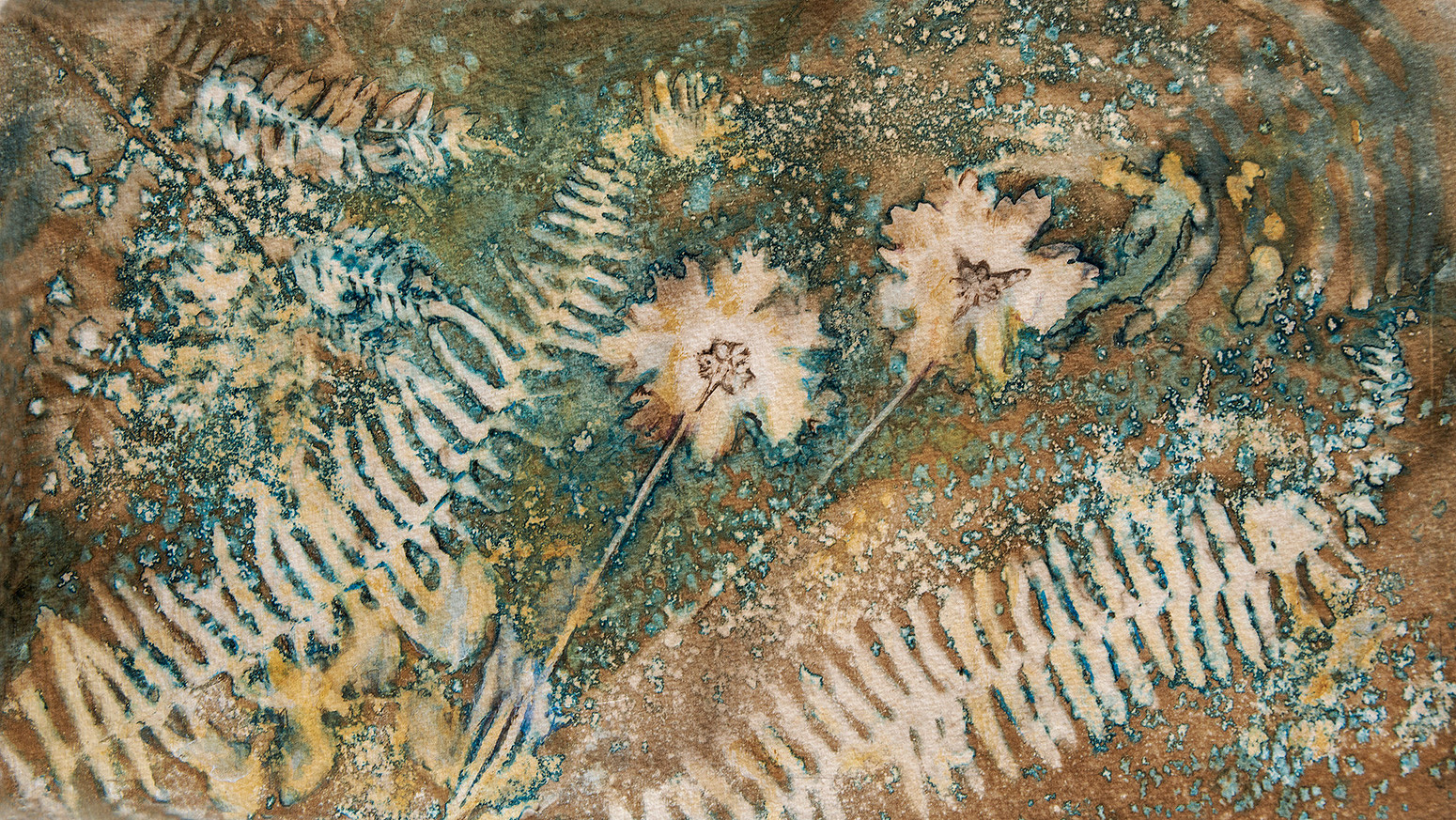
Russell and Stockdale each explore their personal history through photographs of botanical subjects. Russell's images of plants found on her family's property in San Diego's backcountry are paired with actual botanical specimens, often affixed directly to her photographic prints. These artworks speak to the ways she experiences the land—spiritually, emotionally, artistically, and scientifically.
The stunning beauty of Stockdale's images of a seed pod flowering then withering belies the very personal meaning and intent behind his photographs. Their bold colors fade to earth tones, referencing the slow destruction of Alzheimer's disease. Through these photographs, he investigates mortality, memory, and loss.
Curious about a piece? Click any artwork image to learn more
My artwork centers on land and place: its power, beauty, use and abuse, and our desire for it. I am motivated and guided by my love of the land and climate crisis activism. I want my artwork to enter the imagination and heart of the viewer and serve as a spark to ignite thinking about how one chooses to live.
I photograph for reasons Robert Adams articulates in Beauty in Photography: "the effort we all make, photographers and non-photographers, to affirm life without lying about it. And then to behave in accord with our vision."
I acknowledge that the land where these photographs are taken and the plants collected is the traditional territory of the Kumeyaay.
Come for a walk with me and see and feel and get to know this place, my family's property in the high desert backcountry of San Diego. With my camera and plant field press, we'll wander through the oaks, sage, grassland, and chaparral with a backdrop of cowgirl mountains and expansive sky. Most of my photography is done here where my grandparents had their cattle ranch the first half (plus some) of the 20th century, where my mother grew up, where I played as a child and still play today. It's my sacred place, my paradise and my storm.
I walk with the many spirits here—the Native American Kumeyaay, the 1870s settlers, family members, and the more-than-human world: the air, plants, and animals. They seep out of the ground and float around me as the land remembers and expresses the past and poses questions for its future. As my meandering mind roams from my ancestors and the Native Americans, to the oak trees dying from drought and Golden Spotted Oak Borer, to the intoxicating fragrance of sagebrush, this place tells me its secrets, and laughs and cries with me.
I photograph when the land grounds me in the present and I feel its heartbeat and sense its breath. We dance. Memories and the future become the present. I lose the human-centered world and open to engaging with the biosphere. I am part of nature. I don't own it. Caught in the spell of these sensations, I photograph and collect the plants and their seeds to save them from an uncertain future.
I resist my culture's settler colonialism and capitalist drivers of land use that separate humans from nature. Making photographs renews my oneness with nature and the value of being a steward of the land and working to slow the climate crisis. Getting to know and love a place may be the essential thing needed for us to save it, to change our ways.
Wanting to visually translate how I experience the land—spiritually, emotionally, artistically, and scientifically—led me to pair the photographs with botanical specimens and short written pieces, putting the spiritual and the physical together to express my relationship with this land.
Douglas Stockdale (American) is an artist and editor of PhotoBook Journal, the contemporary photobook magazine, on the faculty of the Los Angeles Center of Photography (LACP) and Medium Photo (San Diego). Stockdale investigates various aspects of memory while being fascinated by science. He has been published by Punctum Edizioni (Rome, Italy), self-published three limited-edition artist books, and two photographic guides. He is represented by Fabrik Projects (gallery), Los Angeles, and his studio is in Orange County, California.
Memory Pods is an investigation of aging, mortality, memory, and loss. My semi-abstract and anthropomorphic subject is the flowers and seed pods of aloe vera plants. The progression of flowers going to seed—where biological memory resides—is representative of youthful vibrancy, middle-age muddling, and at the end, when the memories are gone. In the final stages of this botanical progression, I observe the ensnarled and weathering that mimics the tangled masses in the brain of those afflicted with Alzheimer's disease.
We take our ability to retain a memory for granted; nevertheless, with the onset of dementia and Alzheimer's disease, those memories can be frustratingly lost. Forever. Alzheimer's disease or other neurological memory diseases painfully intervene in an individual's life, essentially creating hollow shells of once-vibrant individuals. Those who suffer initially do not outwardly appear different than before the onset of memory loss, but subsequently profound physical and memory changes occur quickly. When our brain ceases to hold any memory, there is also the loss of the individual. We exist through our memories. Such was the case of my late mother, grandmother, and great-grandfather, whose angst having experienced terrible memory loss as a result of Alzheimer's disease. All of whom had an early-onset condition that meant they left us too soon.
During the degeneration process, there are phases of intense sadness, anger, bewilderment, confusion, and deepening depression until all memory has transpired, then individual's memories go blank. Even before these memories are lost, an afflicted person has awareness and a growing realization that something is tragically wrong. Concurrently, the individual's family and other caregivers experience similar mental and physical stress. Family members can experience bouts of gloom and self-doubt, as though living under a lurking gray cloud constantly hovering overhead, as to the potential consequences of this inheritable and dreadful disease. I know.
The elegant botanical portraits can be a pleasure to contemplate while considering how the evident beauty may only hint at the chaos that is concealed within.


